born with a creative force and the ability to imagine the impossible and the sublime. Along the way, some step off the artist’s path but it remains within us, an enduring ember of potential.
No matter where my own path has taken me, the journey has always led home - to my land, culture, origins, heritage... to my community. This is where I find the truest expression of myself and my art.
In both my artistic practice and thinking process, I gravitate towards the themes of memory and time, exploring their polarities and the infinite space of mystery between them. A lifelong diarist, my journals have been in themselves part of my creative process; a dwelling place for my ideas, experiments, observations and interactions. These evolve together through time as my own perspective as an artist continues to shift.
As I continue on this journey, moving enthusiastically through unknown places, I invite you to join me through a series of unfolding patterns in thinking and in making.
When Does Dye Become Dying?
16 March 2026
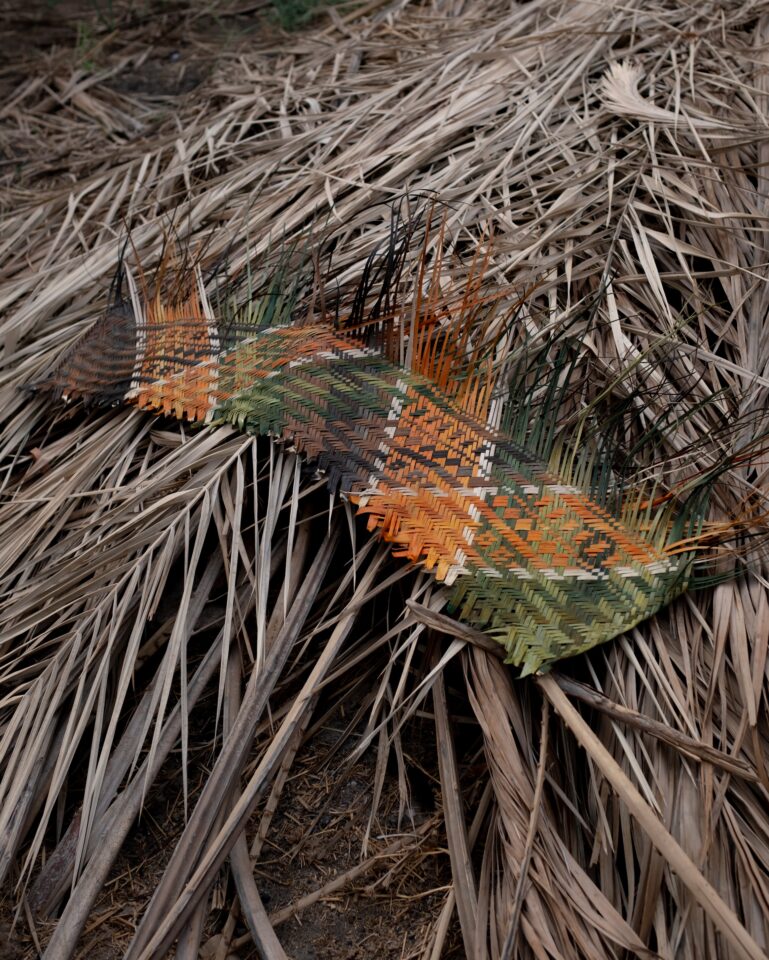
Handwoven Khous (palm leaflets) resting on dried palm fronds, the Julayjilah palm farm, Al-Ahsa. Photo: Latifa AlBokhari
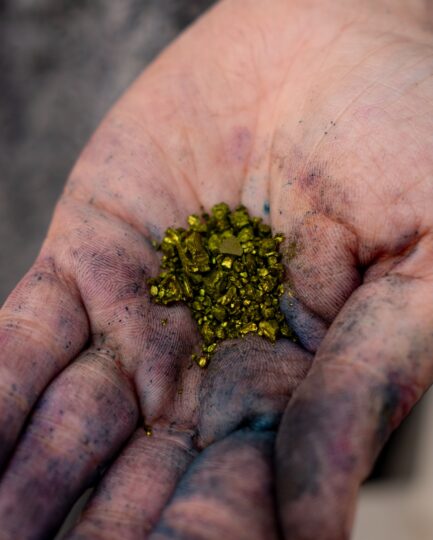
Ma’souma opens her palm. The skin stained blue and purple from dyeing. “Take a picture of my hands,” she says. In the center lies a small mound of metallic crystals, green-gold in the sun. She calls them qurmoz, the ancient name for crimson insect dye. Yet here it refers to something else: synthetic crystals purchased from the market, sealed in thin plastic bags.
Names linger even when materials change.
The tradition survives exclusively by ingesting its own antidote.
Ma’souma holds synthetic dye crystals locally referred to as qurmoz, Al Julayjilah palm farm, Al-Ahsa. Photo: Latifa AlBokhari
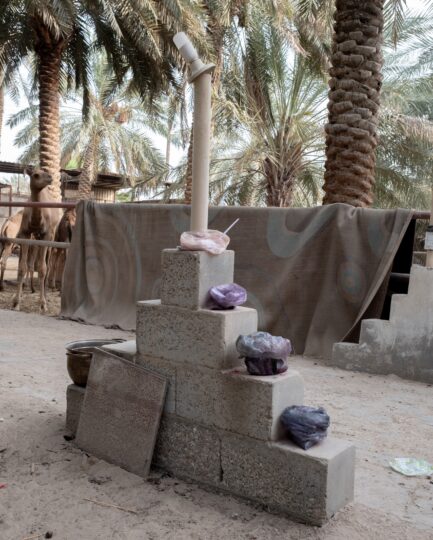
Synthetic aniline dye crystals used to color palm fibers, stacked on concrete blocks in a palm grove in Al-Julayjilah, Al-Ahsa. Photo: Latifa AlBokhari
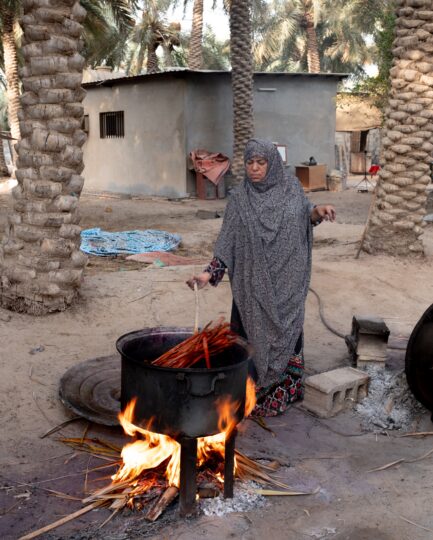
Palm fibers dyed over an open fire using synthetic dye crystals, Al Julayjilah palm farm, Al-Ahsa. Photo: Latifa AlBokhari
To dye is a mechanism of disguise. It also declares mortality. Watching the boiling pots brings a direct awareness of the proximity between dyeing and dying. Across the yard, beside the camels, stacks of concrete blocks support sacks of chemical pigments. The agrarian landscape and the chemical market occupy the same ground.
I sit by the open fire with a specific desire: to build a palette derived from the biological procession of the palm. I ask her to extract the heavy amber of a ripening date and the brittle brown of a dried leaflet. We drop the market crystals into the boiling water. They dissolve instantly. Crimson spreads through the black pot. The color remains, though its biological source has disappeared.
Against this artificial intervention, the date palm writes a strict biological narrative.
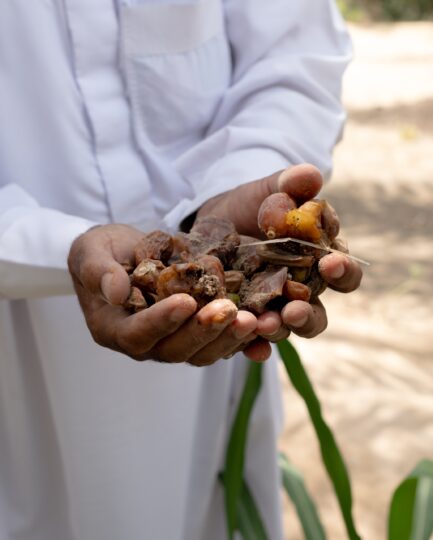
Abu Mohammad collecting fallen dates in the palm grove, Al Julayjilah palm farm, Al-Ahsa. Photo: Latifa AlBokhari
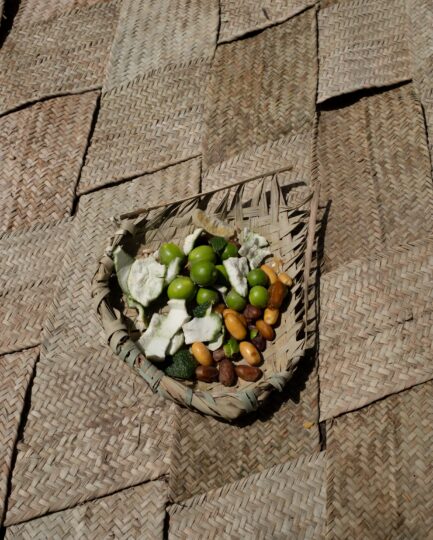
Handwoven palm mat with freshly harvested dates, Al Julayjilah palm farm, Al-Ahsa. Photo: Latifa AlBokhari
The procession of the palm is relentless. It begins with the lush green of new leaflets and the heavy amber of young dates. Time pulls the organism forward. The leaflets dry, turning beige and brown. The dates ripen and fall to the earth. Abu Mohammad, the farm owner, walks through the grove at his Al Julayjilah palm farm in Al-Ahsa, picking up the fallen fruit from the dirt.
Weaving these dyed leaflets together produces a historical document.
The bright yellows of the palm’s youth interlace with synthetic greens, brittle browns, and deep oranges. The chemically altered tones saturate the dry natural fiber where tradition meets the contemporary world. These woven forms reveal how objects continue to emerge from mutation and ending, mapping a way to live with what is already there: altered, reconfigured, and intensely alive.
Are we cooling the water or cooling our conscience?
6 August 2025
Al Jafr, Jordan — July 2025
I took this photo a little over two weeks ago, at the house of the Bedouin woman I’ve been working with. I didn’t expect to see it. I just stood there, looking. Then I took the picture. Since then, I’ve been coming back to it, on my phone, in my head. Something about it won’t leave me.
Three water vessels sitting like travelers who arrived from different times but found themselves sharing the same patch of sun. The first is old and wise, made of clay, rounded like a woman’s body. She wears burlap the way one wears experience, like a second skin. Like a seasoned nomad dressed for the journey. She cools the water without effort. The way it’s always been done. She doesn’t perform her function, she embodies it. So she doesn’t say much…just sits there, confident in her purpose.
Next to her stood two younger ones. Yellow, stiff-necked, made of plastic, less sure of themselves. But they wear burlap too, stitched carefully, almost ritually. As if by copying the elder, they might inherit her function. The wrapping doesn’t cool them. But it remembers something. It enacts something. Maybe that’s enough. In the desert, mimicry is survival, even when no one explains why.
A little distance away stands the green one. Stamped “JO PETROL.” Clearly from another life. He was made for something else. Fuel, not water. But someone gave him a new job. He’s carrying the residue of extraction. Just hard plastic and colonial residue. No burlap. No softness. His plastic is tougher, darker, branded. But he’s here anyway. Reassigned. Repurposed. He stays quiet, watching. He looked different, and he wasn’t wrapped like the others. But he belonged too. He had been chosen. That meant something. That feels like me sometimes…carrying things I wasn’t designed for, but finding ways to keep the thread alive.
The three stood together. Old, new, and changed. Each one made from a different material, each with a different past. But they were all doing the same thing: storing water, standing in the heat, wearing what they could to keep going.
Turns out, in Jordan, even water containers have an identity crisis. A country caught between handmade inheritance and plastic convenience. A place where the past becomes provisional. Not preserved in museums, but reshuffled, wrapped, and reassigned. Because survival here has always depended on adaptation, with or without instruction.
Are the vessels wrapped in burlap because they’re still performing a real function, actually cooling the water, as the clay one does?
Or are we performing the act, copying the look and ritual, to ease ourselves, to feel as though we are still connected to a past, to values, to a system we don’t fully live by anymore?
And the burlap? It’s the costume they all ended up wearing. A borrowed skin. A survival script. But here, performance is practice. It’s how we remember what we’ve almost forgotten, by wrapping it up and pretending it still works.
Welcome to Jordan.
What are we adjusting to, and what’s being erased in the process?
4 July 2025
Women showing me Bedouin rugs their mothers wove, leaning them against concrete walls. A tent cloth mended with denim. Strips of black fabric nailed over windows. A wall painted to imitate the straight lines of a Bedouin tent. Fragments of what once moved now fixed in place. The tent becomes surface. A reference. A memory flattened into structure.
This is what remains. A way of living carried into other forms. Reused, exposed, made to survive. Nothing protected. Nothing forgotten. This is the long aftershock of colonial violence. Displacement extended through architecture. A system that builds permanence over dislocation. That replaces movement with boundary. Relation with separation. Fabric with block.
People continue. They use what stays available. They adjust. But adjustment doesn’t restore dignity. The concrete keeps extending across the desert. And I still don’t know what we’re adjusting to.
So much attention goes to the final object. The thing being made. Less to the tools that make it possible.
Two tools fascinate me for their simplicity. They come from what’s around. You can carry them anywhere.
The Bedouin ground loom (النول الأرضي) stretches across the floor of a home or the open desert, wherever space allows. It’s horizontal. Always anchored. The tension runs between steel pegs. A Bedouin woman works close to the ground—her body leaning forward, hands moving in repetition. She weaves cloth for tents, carpets, partitions, and more.
The ḥabūl (الحابول) is a rope harness. It loops around a man’s waist and helps him climb. Suspended between his body and the palm trunk, he uses it to lift himself upward and collect what the tree gives (dates, fronds, or both). The tension here is not spread out, but pulled tight between two vertical forces.
One tool weaves. The other is woven. One lies on the ground. The other hangs in air. One anchors. The other lifts. Both extend the body into the work.
Tools change. They adjust to place, the task, the body. Working with these tools has changed how I understand making things—how materials are collected, and how things come together. The tool itself is a kind of construction—a device made out of necessity and built for efficiency.
Sometimes the work demands that the tool be rethought. Maybe the tool was never separate from the structure to begin with.
Tools like this ground (نول أرضي) loom are set up wherever space allows. Anchored to metal pegs and weighted by oil cans, it’s a structure that appears, disappears, and appears again
A man holds the ḥabūl (الحابول). The rope harness turns the tree and the body into a single climbing system, held together by tension.
A woman weaves on the ground loom (النول الأرضي), her body aligned with the warp stretched across the ground.
In 2022, I was invited to the UAE to work on a few projects. It had been twelve years since I last lived and worked across the Gulf region. Those invitations reopened a relationship with these places.
Since then, I’ve been moving between places—drawn back for many reasons. Traveling, meeting people, listening. Following a feeling I can’t always name… something between familiarity and distance. Thinking about what connects us, and what doesn’t.
I keep returning to the Bedouin (بدو) of Jordan, and the Hadar (حضر) of the Gulf. Two different contexts. Different ways of being. And still, there are threads — how things are made, how people live, what stays, and what slips away.
But most of all, this movement has turned inward. It’s made me question where I feel ease, and where I don’t. What it means to be held by a place—or not. These reflections have settled in my body, my skin, my breath…in small reactions I didn’t expect.
What do we carry with us? And what gets left behind?
What lives inside a tool passed from one hand to another?
A summer shelter made of palm fronds. Built for the heat, made from what’s close by. Arad, Bahrain, 1963.
Pearl diver. He knots the net basket. Someone once showed him how. Alain Saint-Hilaire/National Archives.
A black tent behind Emir Abdullah I’s palace—light on the land, but it holds everything. Amman, 1925.
Bedouin girl & sheep. She spins wool from her flock. A simple act — and yet everything passes through the hand. بئرالسبع (Biʾr as-Sabʿ),1932. Matson Photograph Collection.
Bedouin woman Outside the Tent. What we wear, how we carry ourselves — it all says something. Between 1898 and 1914, Matson Photograph Collection.